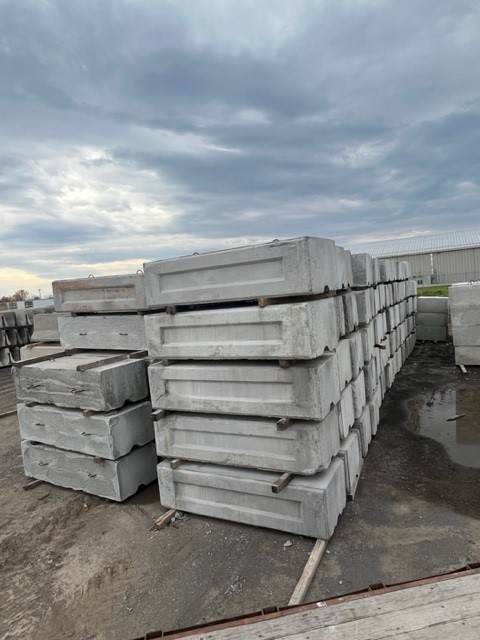
Precast concrete blocks have become a staple in the construction industry and several other fields in recent years, and for good reason. These sturdy and practical blocks can be used to meet a diverse range of needs, both for businesses and individuals.
Real estate developers often use precast concrete blocks to secure a construction area, creating a solid barrier that prevents unauthorized trespassers from entering the site. Construction contractors use these blocks to protect buildings and create additional protective barriers around hazardous areas.
Precast concrete blocks are also particularly useful for snow removal work in winter. Their heavy weight can also make them resistant to violent impacts, such as if they are hit by machinery.
However, the versatility of precast concrete blocks doesn't stop there. They can be used in more discreet settings, such as securing electric charging stations in commercial parking lots or preventing vehicles from crossing natural barriers in forested areas. Concrete blocks can also be used to ensure the safety of fuel storage tanks in a commercial yard.
Finally, precast concrete blocks are very easy to install and can be used immediately after installation; they require very little maintenance and are therefore an economical and practical solution for many construction needs. In addition, they are extremely durable.
In short, precast concrete blocks are one of the most versatile and cost-effective construction tools available today. Whether for real estate developers, builders, or individuals, these blocks have proven their usefulness and effectiveness in creating strong, practical, and reliable structures and work areas. These days, if you take the time to look around you, you'll notice how present they are everywhere in our daily lives.
From now on, any contractor who uses or plans to use concrete barriers on a construction site covered by the MTQ must comply with new documentary obligations.
Batch conformity certificate Each batch of slides, up to a maximum of 50 units, must be the subject of a specific certificate of conformity. This certificate must be issued by the manufacturer or the owner of the units, be dated, signed and numbered, and include in particular:
the name of the manufacturer (if known) and the owner
the batch number and the number of units
workshop drawings or reinforcement verification signed by an engineer
details of the identification plate affixed to the slides
Mandatory compliance notice before installation
In addition to the certificate, the contractor must provide a notice of compliance to the site supervisor at least 24 hours before the first installation of the guardrails.
This opinion confirms that:
The units were inspected
They meet the requirements of the MTQ
Only compliant guardrails will be installed, unless a temporary measure is authorized.
Beware of non-compliant slides
A concrete guardrail is automatically considered non-compliant if it has an identification plate, but cannot be associated with a specific certificate of conformity.
The requirements also stipulate that:
Non-compliant guardrails must be clearly identified
They must be stored separately from compliant units.
Non-compliant units already present on a construction site must be replaced , unless specifically authorized by the MTQ.
Why these new requirements are important
Compliance with the requirements of the CCDG 2025 enables:
To avoid refusals during inspections
To reduce construction site interruptions and delays
To ensure the safety of workers and users
To protect entrepreneurs against regulatory risks
Whether the guardrails are new or used , their conformity is now essential for any road construction site governed by the MTQ.
Working with compliant slides
Ensuring that concrete barriers are fully compliant , with the required documentation, is no longer an option — it is an essential condition for maintaining a compliant and efficient construction site.
A compliant construction site is a construction site without surprises.
Complying with CCDG 2025 requirements can quickly become complex when it comes to documentation, traceability and compliance of concrete barriers. That's exactly where we come in.
We offer concrete guardrails for construction sites that meet the requirements of the CCDG 2025 , so you can work with confidence on your road construction sites.
Specifically, what we do for you:
Compliant concrete guardrails (GBC and GABC), new or used
Identification plates conforming to the MTQ process
Specific certificates of conformity per batch (maximum 50 units)
Complete documentation, ready for the construction site
Support to ensure a compliant installation and no surprises during inspections
Why work with us?
✔️ Reduced risk of refusal or work stoppage ✔️ Saves time on administrative management ✔️ Clear and traceable compliance ✔️ Peace of mind for entrepreneurs and project owners
Whether for a short-term project or to secure your long-term inventory, we help you comply with MTQ requirements from the start .
Leave a comment